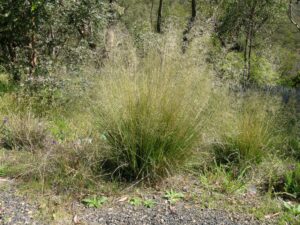
Common names: Japanese chaff flower, chaff flower,
Family: Amaranthaceae
Life form: Perennial herb
History & Introduction
Chaff flower was first reported in the United States in 1981, where it was found in Kentucky and later spread across the Ohio River valley. Its distribution in North America includes Illinois, Indiana, Ohio, Missouri, Kentucky, Virginia, West Virginia, Tennessee, Alabama, Mississippi, Georgia, Ontario, and now New York. Chaff flower is listed as a prohibited species in New York, which prohibits its possession, transport, importation, sale, purchase and introduction.
Native to East Asia, including Japan, Korea, and Taiwan, chaff flower has been used as a traditional medicine. It has been a remedy for conditions such as arthritis, and has been studied for its antioxidant and anti-inflammatory properties. One study found that extracts of chaff flower have shown promise in controlling plant-pathogenic fungi. However, as chaff flower is spreading rapidly in the United States, it poses a danger of outcompeting native species in a variety of habitats.
Identification & Biology
Starting in April, oppositely arranged leaves of chaff flower can be seen with arching veins, similar to dogwood leaves. These leaves are oval shaped to egg shaped (ovate-elliptic).
As the season progresses, this herb can grow 3-6 feet tall, with up to 80 stems per square meter. Stems are squarish in cross-section. The nodes of the plant, where leaves meet the stem, may have a distinctive red tinge to them. As a perennial, this plant will regrow from its dense root system every year.
In August, flower spikes form and resemble a bottle brush. These green flowers mature to green-brown fruits with bracts that face downward against the stem as they develop into the fall. These fruits easily attach to clothing and animals, making it easy for the plant to hitchhike to new places. As a member of the Amaranth family, seeds are produced abundantly.
In the autumn, the leaves will brown and fall but leave the fruiting spikes intact, creating a long window for potential seed dispersal.
Look-alikes:
Lopseed (Phryma leptostachya) is a native lookalike of chaff flower. Lopseed has leaves with toothed edges, unlike chaff flower, whose leaf edges are smooth (entire). They have similar-looking fruits; however, lopseed has oppositely arranged fruits on the stems with bracts at the ends of the fruits, whereas chaff flower has more alternately arranged fruits with bracts at the base of the fruits, close to the stem.
Damage & Concern
Chaff flower thrives in a variety of habitats, including floodplains, forested wetlands, ditches, vacant land, and other disturbed edge habitats. It can thrive in varying light conditions from full sun to shade, though growing best in partial shade. This plant spreads readily through seeds, as it can produce over 1,000 seeds per plant. These seeds can spread by attaching to clothing and animals, including migratory birds. Seeds can also move long distances along waterways.
Chaff flower can become a dominant understory plant in areas where it has invaded. As it grows in dense monoculture stands, it has the potential to outcompete native species.
Management
Avoiding the spread of chaff flower seed is very important. Management should occur before late August, when this plant can begin to go to seed.
Manual Control
- Manual control can be effective for sparse individuals or very small populations. Hand pulling may be effective in early spring, as plants are emerging. Removing all parts of the roots is necessary to ensure the plant does not resprout from root parts. For this reason, digging is recommended more than hand pulling. To avoid the risk of spreading seed, do not attempt to manually remove chaff flower once it has set seed.
Mechanical Control
- Mowing can be used to suppress plant populations, but may not eliminate them entirely. Mowing or cutting can be used to delay seed set. Mowing should only occur before late August, when the plant can begin to set seed.
- Prescribed burns have a negative effect on chaff flower, increasing the likelihood that they may not resprout the following year if applied to mature plants. However, this method may not eliminate chaff flower populations on its own.
Chemical Control
- Chemical control through herbicide applications has proven to be effective to manage chaff flower where it occurs in other states, especially for large infestations. Effective herbicides used in other states include triclpoyr, glyphosate, and 2,4-D. As law dictates, remember to follow all instructions on the herbicide label.
Dispose of the chaff flower in garbage bags off site, or solarize material before dispoal. Be sure to check clothes and gear for any seeds before leaving the site, and cleaning gear and clothes with boot brushes.
Monitoring or Reporting
LIISMA is currently monitoring chaff flower as part of our Early Detection and Rapid Response Program. As reports of the species are collected, LIISMA is working with partners to delineate and manage any early emerging infestations before they become widespread. Chaff flower is currently a Tier 2 species within LIISMA, prioritized for eradication.
Your reports matter to us – please report the species to iMapinvasives or iNaturalist as soon as you detect it.
If you are interested in playing a bigger part in protecting our local flora and fauna, consider joining LIISMA’s Invasive Species Spotter Program! This program teaches you how to spot emerging invasive species as they arise, giving you valuable detection skills against occurrences of invasive species that were not previously on LIISMA’s radar.
References:
- Choi Chang-Yong, Nam Hyun-Young, Chae Hee-Young (2010). Exotic Seeds on the Feathers of Migratory Birds on a Stopover Island in Korea. Journal of Ecology and Environment Volume 33, Issue1, p19~22, 28 10.5141/JEFB.2010.33.1.019
- Evans, Chris (2021) Japanese Chaff Flower Identification, Ecology, and Distribution. YouTube. https://www.youtube.com/watch?v=eP1mz1fA5Jw
- Kamstra, J. 2019. Japanese Chaff-flower, Achyranthes japonica (Amaranthaceae), on the Erie islands, an invasive plant new to Canada. Canadian Field-Naturalist 133(1): 56–59. https://www.canadianfieldnaturalist.ca/index.php/cfn/article/view/2161/2203
- Kim, J.-C., Choi, G.J., Lee, S.-W., Kim, J.-S., Chung, K.Y. and Cho, K.Y. (2004), Screening extracts of Achyranthes japonica and Rumex crispus for activity against various plant pathogenic fungi and control of powdery mildew. Pest. Manag. Sci., 60: 803-808. https://doi.org/10.1002/ps.811
- Michigan Invasive Species (2023) State of Michigan’s Species Profile for Chaff Flower (Achyranthes japonica) Management https://www.michigan.gov/invasives/-/media/Project/Websites/invasives/Documents/TIS-Profiles/ChaffFlower_profile.pdf?rev=49d9efc57d2b4450a29880151ae19fd3&hash=D3E84BF018CE0EBD15D2210E360CC658
- Purdue Extension (2013) Japanese Chaff Flower. Southern Indiana Cooperative Weed Management Area. https://www.extension.purdue.edu/extmedia/fnr/fnr-477-w.pdf
- Young Bang, S., Kim, J. H., Kim, H. Y., Ji Lee, Y., Young Park, S., Joon Lee, S., & Kim, Y. (2012). Achyranthes japonica exhibits anti-inflammatory effect via NF-κB suppression and HO-1 induction in macrophages. Journal of Ethnopharmacology, 144(1), 109–117. https://doi.org/10.1016/j.jep.2012.08.037