

Scientific Names: Celastrus orbiculatus
Common name: Oriental bittersweet, round leaf bittersweet, and Asiatic bittersweet
History & Introduction
Native to eastern Asia region, China, Korea, and Japan, round-leaf bittersweet (Celastrus orbiculatus) made its debut in North American as early as 1800s. Its introduction can be traced back to the Kissena Nurseries in Queens, New York, known at the time for importing ornamentals. Round-leaf bittersweet grew in popularity for its vibrant yellow and red-orange fruits, creating decorative landscapes that landowners admired and quickly led to widespread plantings in the Northeast.
By 1974, round-leaf bittersweet had escaped cultivation across 33 states and was classified as invasive in 21 of them. By 2011, the vine was thoroughly established across the Northeast. Today, it can be found growing aggressively along forest edges and in the understories of wooded areas. As a vine, it can be seen creeping into early successional fields and coastal areas, especially if the area has experienced soil disturbance.
Identification
Round-leaf bittersweet is a deciduous, woody perennial vine that climbs neighboring trees or spreads across the ground as a trailing shrub. Growing up to 60 feet in length and the main stem can grow to 4 inches thick in diameter. Young stems are tan to dark brown with visible lenticels, whitish bumps/dashes. As the vine matures and thickens, the bark becomes an ash gray tone with long parallel striations and diamond shaped fissures that resemble a fishnet pattern.
The leaves are arranged alternately along the stem, 3 to 6 inches long and 1 to 3 inches wide. The leaves are smooth and hairless, with finely toothed margins. The leaves vary in shape from oblong to nearly circular. The foliage is olive-green throughout the spring summer and turns a bright yellow in late autumn, holding its leaves longer that the surrounding native plants.
Between May and June round-leaf bittersweet produces inconspicuous greenish-white, star- shaped flowers. The flowers emerge in small clusters branching directly from the leaf axils (the upper area where the leaf stem meets the branch). Female plants produce fruits from August to October. At maturity, the outer green/yellow capsules split open to reveal a showy scarlet/red-orange berries that remain present on the vine throughout the winter providing a food source for wildlife.
The vine reproduces both vegetatively and by seed. It develops underground networks of rhizomes that create dense patches above ground across a wide range of soil types. Birds and other wildlife feed on the fruit and disperse the seeds to new locations, eventually establishing new infestations far from the original site. Once on the ground, the seeds overwinter and have a germination success rate of up to 95%. Unlike many plants, round-leaf bittersweet does not require sunlight to sprout and can actually reach their highest germination rates in the dim light under a thick forest canopy, allowing it to dominate forest understores.
Native Lookalikes:
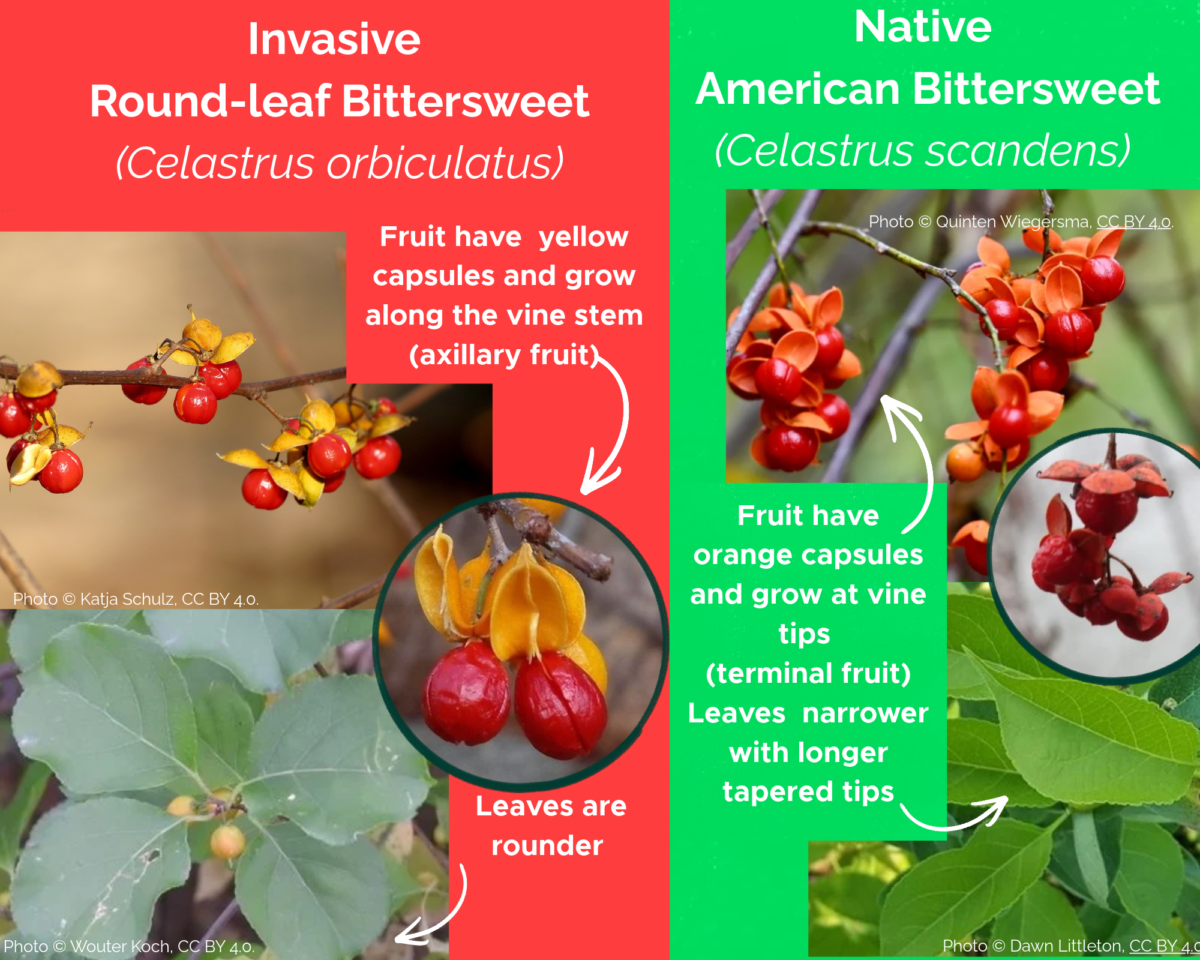
Round-leaf bittersweet resembles our native bittersweet, American bittersweet (Celastrus scandes). The two are often mistaken; they differ slightly by their leaf shape and where the fruit sits on the vine. The invasive round-leaf bittersweet (C. orbiculatus) leaves are rounder. Their flowers and fruit grow in small clusters of 3 to 7 on the leaf axils all along the length of the stem. The native American bittersweet (C. scandens) leaves are consistently narrower with longer tapered tips. Flowers and fruits form only at the very tips of the stems. American bittersweet’s fruit capsules are also orange, compared to the invasive’s yellow capsules, though both have red inner fruits.
It’s important to correctly identify the two because the invasive round-leaf bittersweet is actively displacing and hybridizing with the native American bittersweet. Areas that historically planted round-leaf bittersweet when it first arrived, especially in the Northeast, have seen declines in the native variety. The genetic integrity of the true American bittersweet is threatened throughout the Northeast. In Connecticut, American bittersweet is now listed as a Specie of Special Concern due to population loss.


Ecological Damages and Concerns
Round-leaf bittersweet uses neighboring shrubs and tree trunks as ladders as the vine twines around branches until it reaches the tops of canopies. Eventually the tight coils thicken over time and lead to girdling (choking) of tree trunks and branches. The girdling constricts the trees’ vascular flow of water and nutrients. Once it reaches the tops of canopies its foliage forms dense mats covering the host tree, blocking sunlight which in turn hinders the host from photosynthesis. The thick vines also add an extra physical load on the upper branches that can put additional strain on the tree limbs. Trees affected become top heavy and are prone to snapping or uprooting during high wind events and heavy snowfall.
Because the vine acts as a metaphorical bridge connecting the forest floor to the tops of tree canopies, it can act as a fuel ladder in forest fires. In a brush fire, the dry woody vines add substantial fuel to the understory and increase the risk of the ground fire climbing into the treetops, resulting in destructive crown fires.
Management Control
Successful round-leaf bittersweet management requires persistence, regardless of which control method you choose. Plan to monitor the site the following growing season to address resprouts from the roots and any newly germinating seedlings.
Manual control:
Small infestations and young seedlings can be pulled by hand or dug out, being sure to excavate the entire root system. Leaving even a small underground rhizome fragment behind will trigger resprouting. Bag all pulled roots and fruiting stems on heavy duty trash bags for disposal, never compost them.
Regular, weekly mowing or cutting over several years can eventually exhaust the carbohydrate reserves stored in the root system. Infrequent mowing will stimulate denser root suckering
Chemical control:
Where mature vines have begun to girdle trees it is helpful to cut the stems near the ground and another cut a chest height known as a “window cut”. Cutting between July and August, before the berries ripen, will deplete the roots carbohydrates and minimizes resprouting compared to spring or fall cuts. Make cuts close to the ground and immediately apply a systemic herbicide containing triclopyr to the freshly cut stump surface. Applying the herbicide right after cutting allows the plant’s natural vascular tension and turgor pressure to draw the treatment down into the roots. The upper vines can be left hanging; eventually they will decompose and will fall on their own within two to three years. Avoid cut stump treatments when the ground is frozen in the winter.
In appropriate situations where foliar spraying is feasible. The patch should be cut down to ground early in the growing season around April. Allow the vines to resprout for roughly one month, then apply a 2% foliar spray of triclopyr to the new leaves.
When using any herbicide, always read and follow the manufacturer’s instructions carefully – remember, the label is the law!
Control and LIISMA Ranking
Under New York State regulations 6 NYCRP Part 575, round-leaf bittersweet is classified as a prohibited invasive species, meaning that it is illegal to knowingly purchase, sell, import, transport, propagate, or introduce round-leaf bittersweet by any means.
To prevent the initial establishment of round-leaf bittersweet it’s necessary to practice Early Detection and Rapid Responses (EDRR). Although round-leaf bittersweet is classified as a Tier 4 species, LIISMA actively surveys and manages emerging stands within our high priority Invasive Species Prevention Zones (ISPZs). These ISPZs have high ecological value with an abundance of native plants which supports rare species or home to unique habitats. Implementing EDRR in these relatively uninvaded areas is needed for maintaining New York State’s biodiversity.
Works Cited
Del Tredici, Peter. “Untangling the Twisted Tale of Oriental Bittersweet.” Arnoldia, vol. 71, no. 3, 2014, pp. 2–18. The Arnold Arboretum of Harvard University, arboretum.harvard.edu/arnoldia-stories/untangling-the-twisted-tale-of-oriental-bittersweet/.
Dreyer, Glenn D. “Celastrus orbiculatus.” BugwoodWiki, edited by John M. Randall, Center for Invasive Species and Ecosystem Health, 22 May 2013, wiki.bugwood.org/Celastrus_orbiculatus. (Alternative without author: “Celastrus orbiculatus.” BugwoodWiki, Center for Invasive Species and Ecosystem Health, wiki.bugwood.org/Celastrus_orbiculatus. Accessed 18 Nov. 2026.)
Fryer, Janet L. “Celastrus orbiculatus.” Fire Effects Information System, U.S. Department of Agriculture, Forest Service, Rocky Mountain Research Station, Fire Sciences Laboratory, 2011, www.fs.usda.gov/database/feis/plants/vine/celorb/all.html#PlantGrowth.
“On the Lookout for Non-Native Invasive Plants: Oriental Bittersweet.” N.C. Cooperative Extension, Madison County Center, North Carolina State University, 23 Apr. 2025, madison.ces.ncsu.edu/news/on-the-lookout-for-non-native-invasive-plants-oriental-bittersweet/.


